A state-by-state journey
U.S. Surrogacy Map
Surrogacy law varies by state and can change. This map is a starting point; RHEA coordinates qualified reproductive counsel for your specific journey.
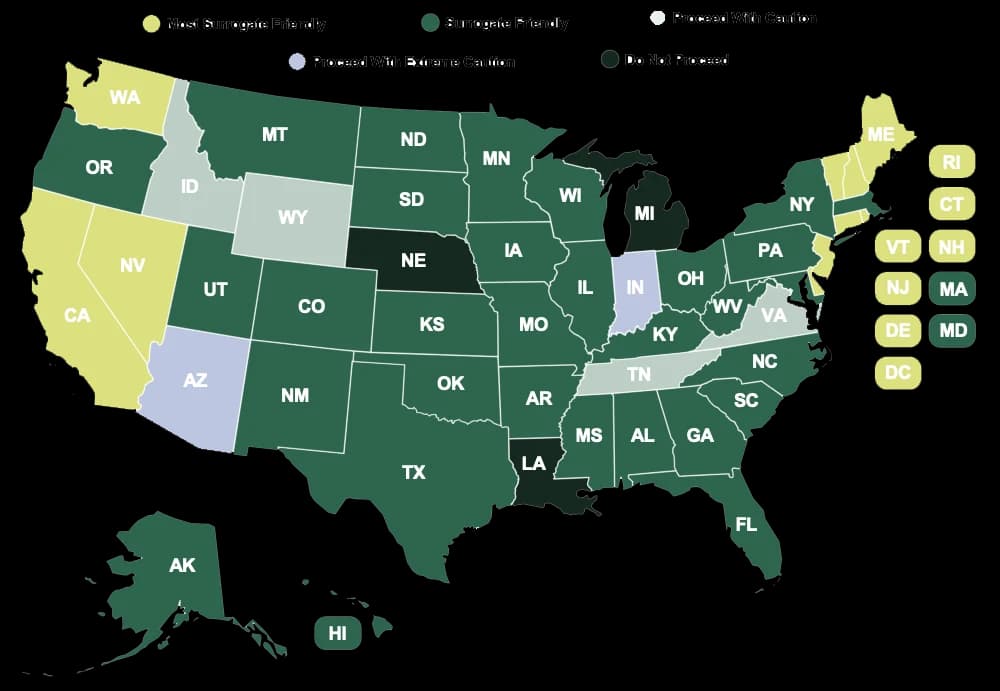
Explore each state
Surrogacy Laws by State
Alabama
Gestational Surrogacy is allowed in Alabama. No statute or case law prohibits it. Courts are generally favorable to Gestational Surrogacy arrangement.
Alaska
Gestational Surrogacy is allowed in Alaska. No statute or case law prohibits it. However, there are many variables regarding surrogacy in Alaska.
Arizona
Arizona law prohibits all surrogacy agreements. While surrogacy contracts are unenforceable, gestational surrogacy is still practiced in the state.
Arkansas
Gestational Surrogacy is allowed in Arkansas. However, results may vary based on marital status, sexual orientation, and biological relationship to the child.
California
Gestational Surrogacy is fully permitted in California. Surrogacy agreements are enforceable and pre-birth orders are easily obtainable.
Colorado
Gestational Surrogacy is allowed in Colorado by statute, which clearly sets out the requirements and enforcement of surrogacy arrangements.
Connecticut
Gestational Surrogacy is fully permitted in Connecticut. Surrogacy agreements are enforceable and pre-birth orders are easily obtainable.
Delaware
Gestational Surrogacy is fully permitted in Delaware as long as statutory requirements are met. Surrogacy agreements are valid and enforceable.
District of Columbia
The District of Columbia fully permits surrogacy agreements by statute since 2017. Court parentage orders cannot be issued until 48 hours after birth.
Florida
Gestational Surrogacy is permitted in Florida for married couples only. All other Intended Parents must take extra legal steps to establish parental rights.
Georgia
Gestational Surrogacy is allowed in Georgia. No statute or case law prohibits it. However, some restrictions may apply.
Hawaii
Gestational Surrogacy is permitted in Hawaii, but only post-birth parentage orders are granted. Therefore, parenthood through surrogacy in Hawaii will require additional legal steps.
Idaho
Gestational Surrogacy is now permitted in Idaho by statute. The law recognizes gestational agreements that meet certain requirements, and such agreements are validated by the courts.
Illinois
Gestational Surrogacy is expressly permitted by statute in Illinois with detailed statutory provisions for enforceable agreements and legal parental rights for Intended Parents.
Indiana
Gestational surrogacy agreements in Indiana are void and unenforceable. However, gestational surrogacy continues to be practiced in the state.
Iowa
Iowa statutory law implicitly permits Gestational Surrogacy. Gestational surrogacy agreements are enforceable pursuant to a decision by the Iowa Supreme Court in 2018.
Kansas
Gestational Surrogacy is allowed in the state of Kansas. There is no statute or direct case law that prohibits it.
Kentucky
Gestational Surrogacy is allowed in Kentucky. No statute or case law prohibits it. However, some restrictions may apply.
Louisiana
In 2016, Louisiana statute restricted gestational surrogacy to married, heterosexual couples who use their own gametes (no donor sperm/egg). Commercial surrogacy is expressly prohibited.
Maine
The Maine Parentage Act of 2016 legalized surrogacy in Maine. Gestational Surrogacy is fully permitted in the state, and gestational surrogacy agreements are enforceable.
Maryland
Maryland is a surrogacy friendly state where all individuals may pursue family building through gestational surrogacy.
Massachusetts
Gestational Surrogacy is permitted by case law in Massachusetts, as established by the state’s highest court.
Michigan
In March 2024, Michigan’s legislature passed an Act which permits Gestational Surrogacy. It is expected to take effect in March 2025. Until then, surrogacy is forbidden, and surrogacy contracts are void and criminal in Michigan.
Minnesota
Gestational Surrogacy is allowed in Minnesota. No statute or case law prohibits it. However, some restrictions may apply.
Mississippi
Gestational Surrogacy is allowed in Mississippi. No statute or case law prohibits it. However, some restrictions may apply.
Missouri
Gestational Surrogacy is permitted in Missouri, but only post-birth parentage orders are granted. Parents may request a hearing regarding parentage to speed up the post-birth process.
Montana
Gestational Surrogacy is allowed in Montana. Montana courts are generally favorable towards surrogacy agreements, but results may vary by county and judge.
Nebraska
Gestational Surrogacy is legal in Nebraska, but surrogacy contracts are void and unenforceable. A 2020 statute allows uncompensated surrogacy practice in limited situations.
Nevada
Nevada is a surrogacy-friendly state. Gestational surrogacy for compensation is fully permitted in Nevada.
New Hampshire
New Hampshire is a surrogacy-friendly state. Gestational surrogacy for compensation is fully permitted in the state.
New Jersey
The New Jersey Gestational Carrier Agreement Act of 2018 provides for enforceable gestational carrier agreements and pre-birth orders under certain conditions.
New Mexico
A New Mexico statute provides that gestational surrogacy contracts are neither permitted nor prohibited. Gestational surrogacy is therefore considered legal in New Mexico.
New York
Beginning on February 15, 2021, New Yorkers will be legally able to arrange and carry out paid surrogacy agreements.
North Carolina
Gestational Surrogacy is allowed in North Carolina. No statute or case law prohibits it. However, some restrictions may apply.
North Dakota
Gestational Surrogacy is permitted by statute, which states clearly and simply that a child born to a gestational carrier is the child of the Intended Parents for all purposes.
Ohio
Gestational Surrogacy agreements are enforceable in Ohio based on case law, but restrictions may apply and results may vary by county and judge.
Oklahoma
The Oklahoma Gestational Agreement Act (effective 2019) made gestational surrogacy agreements enforceable. Pre-birth orders are issued when certain conditions are met.
Oregon
Gestational Surrogacy is fully permitted, and surrogacy contracts are enforceable. Pre-birth orders are issued when certain conditions are met.
Pennsylvania
Gestational Surrogacy is allowed in Pennsylvania. No statute or case law prohibits it. However, the application of surrogacy law varies by county and judge, especially when donors are used.
Rhode Island
Rhode Island is a surrogacy-friendly state. Gestational surrogacy for compensation is fully permitted in the state.
South Carolina
Gestational Surrogacy is allowed in South Carolina. No statute or case law prohibits it. However, some restrictions may apply and individual results may vary.
South Dakota
Gestational Surrogacy is allowed in South Dakota. No statute or case law prohibits it. However, some restrictions may apply.
Tennessee
Tennessee law neither permits nor prohibits surrogacy, which means surrogacy is legal in the state. Several judicial opinions outline the legal framework for the surrogacy process.
Texas
Gestational Surrogacy is permitted in Texas by statute for married Intended Parents who follow statutory procedures, which include validation of surrogacy contract by a court before birth.
Utah
Gestational Surrogacy is permitted in Utah by statute for married Intended Parents, including same sex married couples, so long as the surrogacy contract is validated by a court pre-birth.
Vermont
Gestational Surrogacy is permitted in Vermont under the Vermont Parentage Act of 2018.
Virginia
Gestational surrogacy is permitted in Virginia but with numerous restrictions. For example, only Intended Parents who meet all statutory criteria can obtain a pre-birth order.
Washington
Gestational Surrogacy for compensation is legal in Washington from January 2019. Gestational surrogacy agreements are now legal and enforceable.
West Virginia
Gestational surrogacy for compensation is allowed in West Virginia, however certain restrictions may apply.
Wisconsin
Gestational surrogacy agreements are valid and enforceable, unless contrary to the child’s best interest. Other restrictions may apply by county.
Wyoming
Statutory law in Wyoming neither permits nor prohibits surrogacy. Since surrogacy law is unclear in the state, Intended Parents may face legal hurdles in their surrogacy process.